Remix project via Disquiet

December 3rd, 2010 by alec

I’ve got a new remix on the Disquiet ambient music site run by Marc Weidenbaum. It is for a podcast called Vox Tablet, who was doing an episode on Hannukah music reinterpretations. Some artists were asked to remix holiday music, others like myself the podcast theme.

It’s song #2 here.

Generative Music, an experiment (no. 16)

September 21st, 2010 by alec

I’ve recently (as in, over the past few years or more) been fascinated with the concept of generative music, something that Terry Riley first brought to my attention (see my blog entry and version of his aleatoric/generative composition “in C”) and that of course Brian Eno has championed. Eno has found success with many different generative systems, most recently and notably a series of iPhone apps including Bloom which compose random ambient music based on a handful of parameters the user defines.


Wanting to tackle something like that myself, but wanting to start simple, I found that I can do this with Ableton Live and the sample devices that come with the Max for Live package… without even opening Max itself.

Max For Live's MIDIgran effect

The Follow Action feature with 8:1 odds of repeating vs stepping back to the previous clip.

Using the randomized sequencing trick I used in “In C”, plus the Max for Live MIDI effect “Max MidiGran” I was able to take a simple 2-note passage (that forms the main drone) — playing only very long notes of C and F alternating which you can here, below — then separately for each of 2 additional “solo” synths, repitches randomly and remaps to a note on the C major pentatonic scale. These come and go randomly based on probabilities I set up and on multiples of 8 bars.

Then I added a drum machine loop, which also comes in based on random probabilities.

Finally, I added another Max effect that brings up some random feedback to the main drone and the drum machine at unexpected moments. Might be too jarring for the effect I was originally going for though.

It’s also number sixteen in the ridiculously optomistic “song of the week” project, but better late than never…

DOWNLOAD:

#16 Opalize (mp3, 24MB)

UPDATE: Here is another mp3 generated by the same setup. Very similar of course, but different!

#17 Opalize (reprise) (mp3, 24MB)


rickenbacker suicide, part 2

July 21st, 2010 by alec

Back in May of 2009, I wrote this post about opening the case and finding my once-trustworthy Rickenbacker 12-string to have a broken tailpiece, snapped in two by the tension of the strings.

I found rumors on the net about inferior alloys used by RIC in the late 80’s as well as the unusually high tension of the Pyramid brand of strings I was using. With a new tailpiece and the guitar tuned down a whole step (from EeAaDdGgBBEE to DdGgCcFfAADD), I figured I was in good shape.

Lo and behold, I opened up the case last month and strings were everywhere—the tailpiece had apparently snapped again. Fortunately it was not the floating “R” logo tailpiece this time, but the clasp screwed onto the body that the “R” piece hooked into. In other words, the other half of the older equation, rumored to have the faulty alloy.

I have a hard time believing that it could be the Pyramid strings when I had the guitar tuned down a whole step. Nonetheless, lots of Rickenbacker-obsessed people who spend a lot more time with this sort of thing than I do all seem to be recommending switching strings, so I ordered some Thomastik Infelds just in case, and as a lower tension will make for easier string-bending.

Apparently Rickenbacker corporate hates Pyramids so much that they refuse to let anyone mention them by name on their website, and replace the word “pyramid” with “tetrahedron.” Likewise, using the name of a popular compression pedal that people use to get that Byrdsy jangle (even endorsed by Roger McGuinn himself) is verboten: “JangleBox” becomes “Jingle Bells.” Why they dislike the pedal isn’t entirely clear, aside from vague intimations of copying the built-in circuitry of a unit that’s no longer even made.

Very odd indeed.

Vuvuzela! (USA Wins 1-1 vs England)

June 15th, 2010 by alec

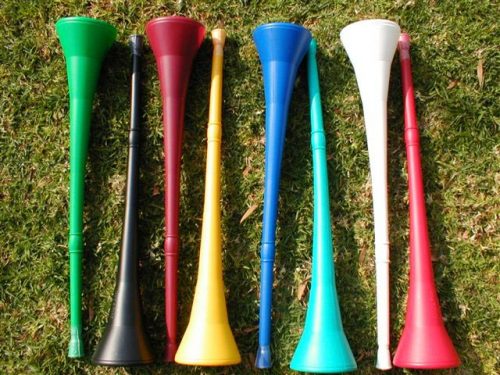
Vuvuzela

If you’ve watched any of the current World Cup, you have an opinion about the plastic horns that the fans use to blare on and drone throughout the matches. Surprisingly, all of my friends seem to like the background noise they provide and find it somewhat soothing. Others, or so I’ve heard, find them extremely annoying and liken them to the sound of attacking hornets. Okay, I will admit that they do sound like a swarm of bees, but I actually like the sound of bees. I am not sure, but I am pretty sure that it’s not a coincidence that the word “drone” is used both for male worker bees and the droning sound that bees make.

So whith that in mind, here is a Vuvuzela-heavy remix of the US-England game this past Saturday, or at least the last 14 minutes of the last half. You can hear the US score the “winning” goal at 5:15 (thanks to British goalie Robert Green, who I offer my sincerest condolences to).

Vuvuzela (mp3)

Iron Chef of Music

March 21st, 2010 by alec

What a cool idea.

Take a short sample, and give anyone the chance to dice, slice, layerand mangle it into a new composition.

And give them only two hours.

I found out about this just today, hours before today’s friendly competition. You can hear my entry and others’ here: http://ironchefofmusic.protman.com

Mystery Instrument Riddle Solved!

March 14th, 2010 by alec

For over ten years, I’ve had this instrument without knowing what it was or where it came from (at least before the music shop in Carrboro, NC that sold it to me used for $20):

Swarsangam and case

Weird looking right? And truly possibly the first “weird” instrument of my collection, if you don’t count the Appalachian mountain dulcimer I made at camp as a kid.

It has four “bass” strings, mounted on a jawari, or “buzz” bridge— the kind you might find on a sitar. When you pluck one of these strings there is a very long sustain with an oriental twang like you might hear in Indian music.

It also has eleven treble strings, mounted across a more normal style bridge, and which make a sharp turn across a series of screws to the end of the box, where somewhat flimsy tuners control their pitches. Someone had installed a “BB Jr.” stick-on pickup. And, it came with a charmingly old-fashioned velvet-lined case.

It was definitely a handmade instrument; the tuners and screws were the only part that appeared to be factory-made. So, I assumed that it was someone’s DIY project that was getting into instrument building and was quite good at it, but wanted to make something really strange and original. I’d assumed it was one-of-a-kind.

For the first 5 years I had it, it was a novelty, not knowing how to tune it or play it. Occasionally it was pulled out to make weird Chinese-sounding plucking noises.

After listening to Ravi Shankar a lot for a few years, though, and then attempting to learn to play a sitar, I realized that this was meant to be an accompaniment instrument, much like the harmonium or tanpura (also known as tambora or tamboura; I don’t attempt to pick a spelling). Tuning the four “bass” strings to the same notes that a tanpura might play sounded really, really good; and knowing that sitar players tuned their 11 sympathetic strings to subsequent notes of whichever scale they are playing in, then it followed that these 11 strings could be tuned similarly. They can be played then, much as a harp or zither, or just left alone to resonate in sympathy with the drone strings.

You can hear it all over the Murmur release Fermata, most noticably the first 12 minutes or so of the second track “Description of the Between.”

It’s also on “OTIII”, the last track of Chef Menteur’s The Answer’s In Forgetting. The tamboura side of the sound is buried beneath banjos and harmonium, but the harp side of the instrument can be heard clearly in the second minute.

You can listen to both tracks online. The links to each song are at the bottom of each page. In both cases we tuned it to open E-flat, as that’s the only key the harmonium we have will drone in. In the liner notes, we listed the instrument as “tamboura/zither box.”

Just this week, I got an email from Dan with a link to another site where the name is clearly listed. It is:

SWARSANGAM.

Here’s a page on Flickr that he found with the instrument’s name and photo. It also hints at the origin of the instrument as a hybrid or synthesis of two instruments:

  1. the drone side is a box tanpura (pictures/shop )
  2. the harp side is a kind of box zither called a swarmandal or surmandal (Wikipediapictures and tuning info). The swarmandal, according to the Wikipedia entry was the instrument producing the harp sound on many of my favorite Beatles songs, including both my wife’s and my all-time favorite song “Strawberry Fields Forever”, as well as “Lucy in the Sky With Diamonds” and the brilliant (but often maligned) Harrison composition “Within You Without You.”

This was very pleasing to read, though not wholly surprising, because it meant that we’d arrived at an understanding of the instrument that’s very close to its common use and purpose in a very organic way by trial and error and deduction; however it did take lots of patience and experimentation with tuning pegs and tuners and a few years messing about with the thing.

orange clouds (no. 13)

January 6th, 2010 by alec

an IDM track put together on the day in mid-december when this photo was taken.

#13 Orange Clouds (7.6MB mp3)

composed with monome 64 and ableton 8 using stretta’s polygome (for max for live).

Automagic Jazz Improvisation

December 22nd, 2009 by alec

Just heard an interesting story on NPR about a Georgia Tech professor’s algorithmic modeling of improvisational styles of jazz musicians like Thelonious Monk and John Coletrane. (I’ve been working on a really basic thing in Max/MSP that can play like Terry Riley on A Rainbow in Curved Air).

There’s video on their site as well with a robot that plays the marimba. Check it out.

Sinewave Workshop: A drone machine in Max/MSP

December 9th, 2009 by alec

I have finally got something that I made in Max/MSP that I like well enough to send out into the world.

This project was started many months ago under the somewhat tongue-in-cheek name “potpie simulator”, and although I have left some visual artifacts to spice up the interface, I changed the name to “Sinewave Workshop” because it simulates my controversial musical friend potpie no more than a stack of AC/30’s and a Les Paul simulates Brian May of Queen. It does simulate his most famous (and crowd-dispersing) setup, such as I remember from the many times Chef Menteur played a show with him, but it differs from a few important ways as well.

potpie_simulator_1.0.7

Sinewave Workshop 1.0.7 for Mac OS X

The bank of sliders allowing you to add harmonics via additional oscillators (and detune them) is not a feature of the classic potpie setup, but would be similar to running the signal through the Electro Harmonix POG or HOG pedals. In addition, the knobs above the sliders give you the ability to detune each oscillator slightly for that groovy “beating” sound common in analog synthesizers and tube/transistor organs.

There is an onscreen mini-keyboard you can use to set the sine wave generator to exact note frequencies (equal temperament, A=440Hz), and you can even attach a MIDI keyboard and play the notes that way for an organ-like sound. If you have a MIDI fader box or other controller you can use that to change the volume and tuning of each slider and detune knob in the harmonics section. I have an Evolution (now M-Audio) UC33e that I use for this.

The range knob on the emulated sine wave generator does not multiply by factors of 10, but by factors of 4, which means that each turn of the knob will raise or lower you by two octaves instead of some non-musical ratio.

There is a little bit of vibrato modulating the sine wave. (I plan to add a switch or knob to change this.)

The delay section simulates one pedal, you can turn off the incoming sample by clicking the light blue square button (or hitting the spacebar) and the delay will continue to cycle. To really get the “potpie sound”, turn the mix up to 100% and the feedback to 90%, and only let sound through sporadically with the button or spacebar (changing notes in between).

Possible future improvements:

  • square wave option
  • Multiple delays, including an 8-second one to simulate the DigiTech 8001.
  • Delays with white noise and 12-bit sampling (for that old school grungy digital sound).
  • Vibrato depth/rate control.
  • Wii-remote control. (Actually I already had this working, but was so hard to set up the Wiimote that I removed it for now.)
  • OSC control… so you can use your iPhone to control it.
  • An “organ” version that allows you to play chords with MIDI keyboard and releases notes when key is released.
  • A Max For Live version

Special

Download link for this project is below. It requires Mac OS X 10.4 to run as a stand-alone app. If you have Max/MSP (version 5 or above) you can download the max collective:

Sinewave Workshop 1.0.7 (standalone application for Mac OS X 10.4 or later)

Sinewave Workshop 1.0.7 (Max collective; requires Max/MSP 5.0 or later)

Enjoy, and please let me know how you like it. I’d appreciate any feedback (no pun intended) from both people wanting to use it as a simple musical instrument and folks who are familiar with Max and take a look at my patch. Note that I have Max For Live and “borrowed” the delay line patch from one of the tutorial sessions; my much more simple one had noticable clicks when you changed the delay time.

RIP Jack Rose

December 7th, 2009 by alec

It has been confirmed that acoustic guitar master Jack Rose aka “Dr Ragtime” has passed away. He was only 38.

Jack Rose was one of the leaders of amazing Virginia experimental band Pelt, and a brilliant fingerstyle guitarist in the “American Primitive” tradition of John Fahey. I only got to see him play once (at the Circle Bar in New Orleans) and a second solo show last winter at the Hi Ho happened to come when I was down with a bad flu, and I remember being very disappointed that I had to miss it, but never imagined that would be my last chance to see him play ever.

A nice tribute to Jack, including video of him performing, from Arthur Magazine.